

Learning from the Masters
Writing and Reading

1.
Mary Oliver wrote “Most writing implies a distant, possible, even probable audience of a few or of many,” which can be found in her book Upstream.1 I quite like that idea. That the author sat down and was thinking of me? Well, I might just blush! Of course, much great art comes not from the artists desire to please that distant audience of which they might not ever know, but from necessity. To this end, Charles Bukowski penned down in his work “so you want to be a writer”:
“if it doesn't come bursting out of you
in spite of everything,
don't do it.
unless it comes unasked out of your
heart and your mind and your mouth
and your gut,
don't do it.”2
Writing is something I have always done. Since childhood. I don’t know why, but it is. Perhaps it was the libraries of my youth full of “dry books” as I’d called them, that inspired me? Or was it my grandmother? What was it that inspired me to write? To this end, I do not know, and in an age when everything must be known, I frustrate myself for not remembering. Maybe I fear that, if anyone was to ask “Why do you write?” I’d have to reply with “I just always have,” and risk being pretentious. Though it is a great relief to hear it from the mouths of great writers like Bukowski, or Mary Oliver:
Neither is it possible to control, or regulate, the machinery of creativity. One must work with the creative powers- for not to work with it is to work against; in art as in spiritual life there is no neutral place… Would one tell [young writers] so soon the whole truth, that one must be ready at all hours, and always, that the ideas in their shimmering forms, in spite of all our conscious discipline, will come when they will, and on the swift upheaval of their wings - disorderly, reckless; as unmanageable, sometimes, as passion?… creative work requires a loyalty as complete as the loyalty of water to the force of gravity. A person trudging through the wilderness of creation who does not know this - who does not swallow this - is lost. He who does not crave that roofless place eternity should stay at home.3
Guilt still washes me out to sea. I spent countless days writing when I should have been job-hunting, working, spending time with family, studying. I was alone most all of that time, confined away. And I can say, none of that writing, to my recollection, was much good at all. Yet it was a necessity. My hands, my mind, drew me before my computer and out flowed a novel of which I shall not name or discuss because I am utterly embarrassed of it these days. Though I still re-read sections from time to time, I suppose it was a fun thought experiment which I rushed headlong into because I felt that I must, must write this. So, hearing from greats is a comfort, but not a remedy.
Rainer Maria Rilke first taught me this lesson when he wrote that “A work of art is good if it has sprang from necessity” and that I should “go into yourself and test the answer to the question whether you must create.”4
2.
And it was Rilke too, who reassured me that those solitary, long hours in which time was made of words and could be rearranged by my own desire to rearrange them so long as I felt it right, was also, in fact, quite necessary. “Works of art,” he wrote, “are of an infinite loneliness,” and that writers should “love your solitude and bear with sweet sounding lamentation the suffering it causes you.”5
We all must retreat inside of ourselves, inside of our cave. It is within this darkness, this world of reclusion and of shadows dancing on the walls that we have a chance to sculpt ourselves, specifically our minds, into what we desire. We can unshackle ourselves from the collective darkness and break that shadow-dancing reality to step behind the wall and see what is there, to see the truth, what we’ve allowed ourselves to be and believe, and in time, we can enter the sun for the first time honestly, and truthfully. Those that escape the cave will be artists, as Plato surmises. Artists in whatever form they choose.
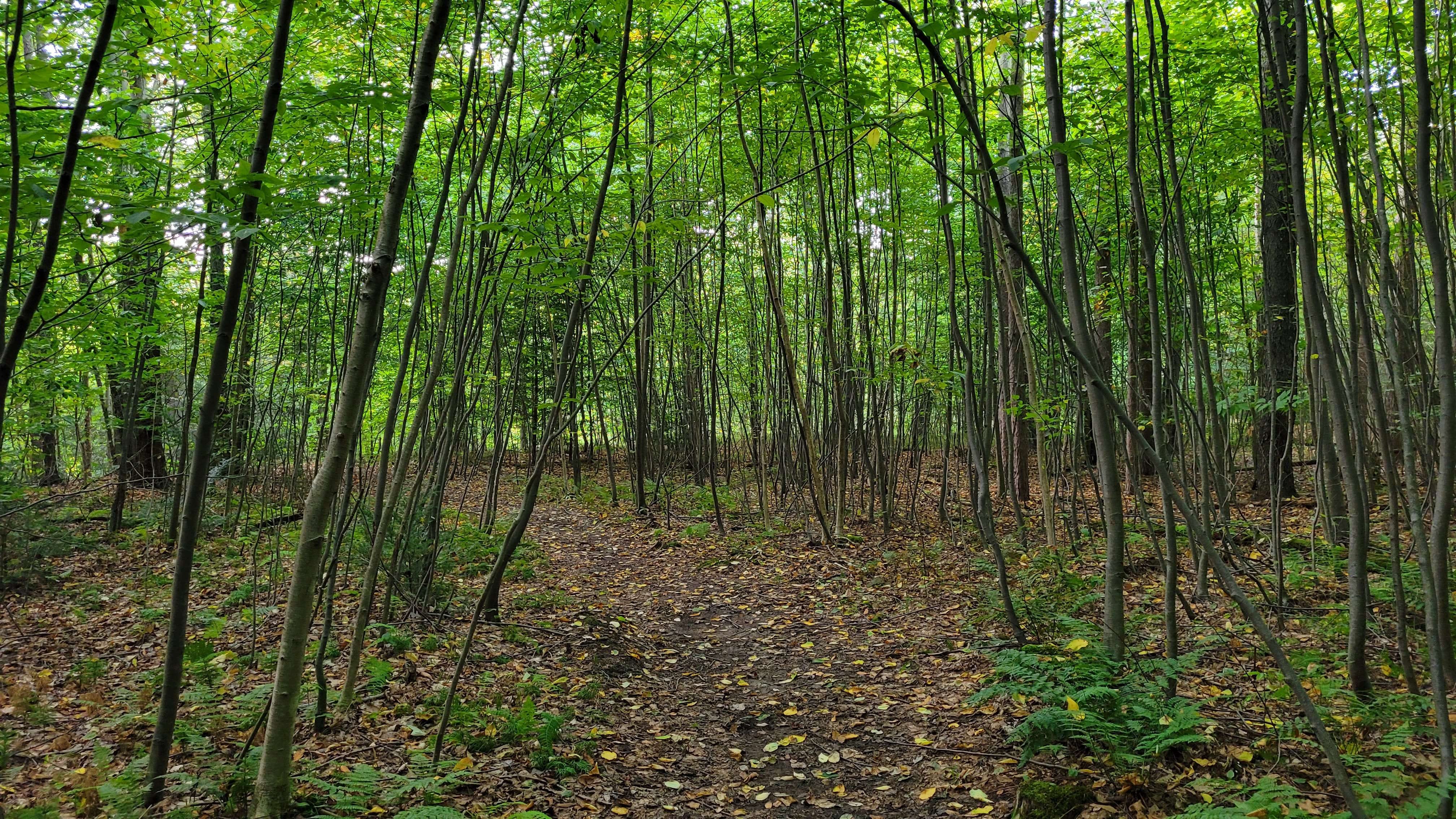
I spend much time alone in the woods, never feeling alone. Though I might miss the company of a fellow hiker, or wish to share the experience, the isolation is good. To be deep in the forest jutting along a path, seeing the sparkling green waters to my right and the dense sea of growth to my left, to hear the Earth breathe, and to feel the occasional silences that mark unseen moments in the out-of-doors. Sometimes the loudest thing is my heartbeat, or the flaring of breath from my nose.
Songbirds whistle as Fall approaches. Their fluttering melodies cascade down upon me as the yellowed leaves of a few already changing leaves do. Trees envelop me and I spot a number of them which tell stories of the landscape and of time itself. Like kingdoms, these massive trees rule over the others. Some are toppled upon themselves and splintered, dead remnants of usurpation to pave way for new life. Others sprout tusk-like branches that give it the appearance of a squid being born of dirt and wood. Others appear wise and old, ivy climbs their trunks and hangs off branches like wisps of hair.
The fields of bramble and golden rod choke the trail as I push through it. I hear the whispers of Aeolus. Leaves upon the ground rustle. Mushrooms appear from fallen branches, around roots. They grow haphazardly all about in oranges, shades of white, red capped domes. I near the water once more and those shimmering naiads beckon me. I go home to write.
3.
There’s that distant audience sitting far far away. A soft speck of light illuminated by an unseen source. I find myself wondering who they are. And then I find I am in the audience, wondering from afar who I’m viewing, a single entity built of words so far off.
I don’t want to say I’m new to reading. I’ve always read. Yet only recently have I taken an interest in authors. I listened to Larry McMurtry’s memoir called Books, which was very good, stuffed full of a cast of 1960’s and so forth antiquarian book dealers and sellers. I built a picture in my mind of what he might look like, and upon seeing what he looked like, well, Larry, let’s say I don’t know how you seemed to have had so many relationships. Now, I’m no catch, and I don’t mean to judge a book by its cover, so to speak.
Looking into authors can be a dangerous game. I found that I don’t quite enjoy much else of McMurtry’s works, they’re just alright. And after reading Blood Meridian by Cormack McCarthy I found The Road much to fractured to continue with in my busy schedule -perhaps next summer. Other times, it can be quite a good experience. I was quite enticed by the writings of Gabor S. Boritt on the American Civil War, and his story was equally fascinating, and my respect for him deepened. Kurt Vonnegut proved interesting in life as in writing, and the Forest Gumpian existence of Gyles Brandreth is endlessly intriguing.
I’m reminded of a story told by, of all people, actor Andrew Garfield who had just read Ocean Vuong’s impeccable collection of poetry Time is A Mother. He was listening to an interview with the author and said “I was just sobbing. I said to myself, Whoever this person is—one day I’m going to marry this woman. And I had no idea that [Ocean Vuong] was a beautiful man, because he has this very sweet, high-pitched tone of voice, and I thought, That’s my future wife. What are the odds?”6
Even when the world makes it so easy to know who an author is these days, some members of their audience, seeing their words from very far away, are so enraptured that all else becomes unimportant. And that, as harsh as it can sound, is a sign of good writing, art, music and so on. It shouldn't matter who the author is, where they are from, what they might believe, what they call themselves, what language they speak or how they sound.
Good art is good art.
And you are very capable of making it.
Oliver, Mary “Some Thoughts on Whitman” Upstream: Essays (2016) p. 103
Bukowski, Charles “So You Want to Be A Writer” sifting through the madness for the Word, the line, the way (2003) https://poets.org/poem/so-you-want-be-writer
Oliver, Mary “Of Power and Time” Upstream: Essays p. 27-28
Rilke, Rainer Maria Letters to a Young Poet (1929) p. 17
Ibid, p. 23, 30
Wang, Esme “An Interview with Andrew Garfield” Culture.org https://culture.org/an-interview-with-andrew-garfield/