

The Back Shop
The Place Where Writers Bloom

If you’re wondering who I am, it’s still Joe from Von’s Bookshelf, I retired the name and moved into a new “era” of my online presence. While you’re here, if you’re new, drop a subscription. It is free, and always will be.
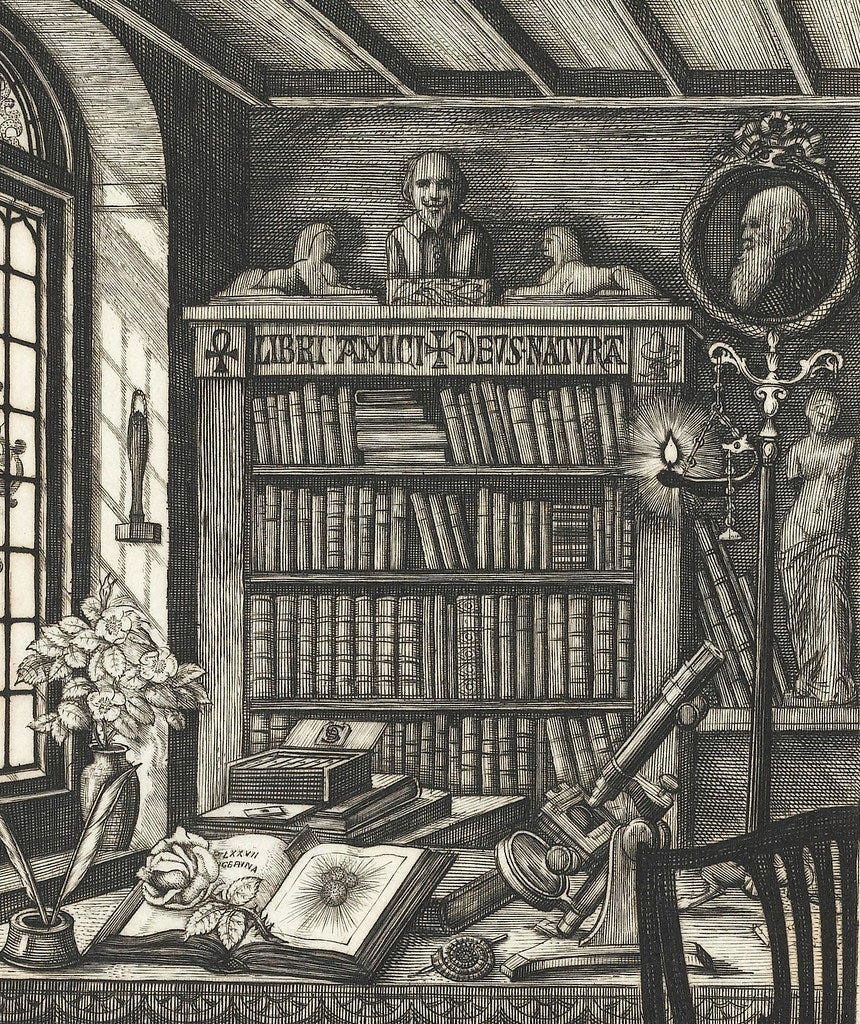
In the grand tradition of so many essayists before, I dare to quote Montaigne. But not yet.
I have always struggled to find the best way to organize my thoughts. For the longest time there simply was no structure. Every idea, thought, opus, light bulb, master work and treatise was lost to the ages. Surely it is that I did not write these things down that I am not considered the great man I dream to be! Verily—
We all mature. For me it felt like a slow process, still is a slow process. No repetition of “Joe is an old soul” will make me feel any less behind than before. Chronic self doubt keeps me chained. However, as I have once written, the introduction of diary keeping into my life was a watershed moment. When on the precipice of a novel virus that still had not yet split the world open and apart, I sensed the seismic moment, and began to put pen to leather-bound paper. From that day on, over six years ago, my life found its way onto the page. It took two years of development from the start of my diary to begin the habit of common-placing. What I perceived to be a Common Place book, however, seems to be, apparently, a Zibaldone. Though the line between Common Place and Zibaldone blurs and blends like mixing watercolors. Quickly, I shrugged the messy distinction off of my shoulders, and carried on. I began my common place notebook in 2022, and have started a third volume this year.
I am slow to mature, feeling ever behind, and slow to fill up notebooks. Just what is worth saving? Almost everything you do or see or read in this life is ephemeral. How do you know just what to write down? If you have this question, I have an answer, but I still do ask myself the same. One thing I can appreciate about the loose definition of the Zibaldone is that it has been described as a “vernacular” common place book. Vernacular here meaning unique to the author. In other words—put whatever you want into your notebook. YouTubers and online intellectuals (real, posers, bros and otherwise) have dropped a litany of “content” describing the notebooks they keep. Let me preface the following critique by saying I too keep a number of notebooks. These creators seem to have nothing short of a score, a full twenty, different kind of notebooks. Common Place books, specified Common Place books, zibaldone’s, prayer books, quote books, word books, reading data books, health and feeling books, journals, diaries, doodle books, book books, note books, flower books, bird books, poop books, books books and more books.
At the end of the day they want to sell you something, but you’re not always buying with cash.
What I encourage you to find is a Back Shop. French Essayist Michel de Montaigne wrote that “We must reserve a back shop all our own, entirely free, in which to establish our real liberty and our principal retreat and solitude.” It is not lost on me that the ever noble Montaigne most certainly means a physical space, one “so private that no outside association or communication can find a place.” A study. A retreat. A, as Virginia Woolf put it, “Room of One’s Own.”1 Both authors refer to an actual space, a room, an office, a table in a corner, a little garden. What I extract from this is the following: make a Back Shop.
What do I mean when I say—conveniently the new name of the once and former Von’s Bookshelf—Back Shop? This to me is, perhaps, a true location, mine is my dining room table for instance, but also a place where you can put all your thoughts without judgement. This is not a new idea, as I have in broad strokes just established, and as you read this, you most likely already contribute into this tradition. What I mean to clarify is that you should have notebooks unbounded by the definitions of common place or zibaldone, or un-touched by the influence of influencers.
Here is a place where, as Niccolo Machiavelli wrote, one is “welcomed with affection.” You can enter your Back Shop and converse with the ancients, the not so ancients, and the moderns by reading and writing freely in your own space, in your own place. Here “I feed on that food which only is mine and which I was born for” as Machiavelli said, where “I do not feel boredom, I forget every trouble, I do not dread poverty, I am not terrified of death.” In this space, your Back Shop, you can bloom into not only the writer you wish to become, but the person you wish to become. Here, you are yourself without judgement, or without shame. Here you begin to understand what it is you really think. What it is you truly feel.
While I keep a number of specific notebooks, all of them have some overlap. These pages are my Back Shop. They form the bulk of who I am by informing what I know, what I believe, and what I love.
I sit down at my dining room table in the mornings and there lies my common place book, my diary, my journal, scrap paper, pencils and pens, and a smattering of readings to peruse. The sun shines in through the garden door and the coffee pot is close by. My pen bites softly across the paper and bleeds words onto the lines of my books. I become myself in my Back Shop. So can you.
Thank you for reading this short post. Please consider subscribing to The Back Shop, it’s free, and always will be.
Woolf is of course writing this from a feminist perspective. That if women had a room of their own in the house, no different than a man’s study, they could produce their own works as great as Shakespeare. Similarly, American journalist Kate Field wrote in the mid-19th Century about her great desire to have an office all her own to read and write in.