

Too Much Hope

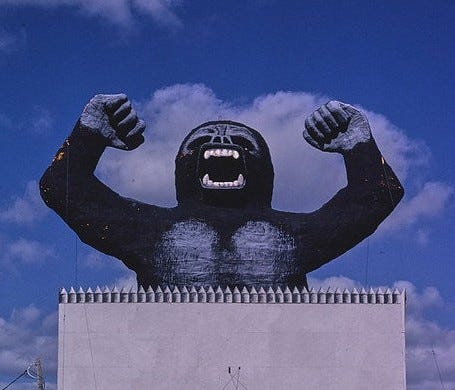
John Margiole, “Rawhide City billboard, I-94, Mandan, North Dakota” (1980) Library of Congress
In the latest issue of The New Yorker I came across an interesting piece in their Talk of the Town section that made me consider something academically uncouth.
I am an Americanist (technically). An Americanist is someone who gets their PhD in American Studies, or AMST for those in the know. Like America, however, an AMST degree is what you make of it. Most academics with American Studies backgrounds self title as Historians, Folklorists, Gender Scholars, Sports Historians, Literary Scholars etc. One thing remains the same among all designations: we study America. As a professor once joked (or counseled) “If an American touched it, it’s American Studies.”
What made American Studies unique is that it built itself upon historical and literary methods. AMST took a novel, say Moby Dick by Herman Melville, and investigated the work as a product of historical and cultural influences at the time it was written. In this way, the whaling culture of 19th Century America is a massive influence, as is Romanticism, Transcendentalism, and the approaching quandary of Darwinism. How to tackle God in a world that seems scientifically, and not divinely ordered? This method was the foundation, but what made American Studies truly stand out was its own idiosyncratic method of understanding the American identity. This we call the Myth and Symbol school of thought.
Myth and Symbol is, presently, a no-go for academics. Critics are right to bring a scalpel to M & S. The assumption that an identity of America could be eked out of its cultural myths and repetitious symbols in the nation’s great works was flawed. Myth and Symbol generally, if not totally, leans on the crutch of the white protestant American experience to create the American identity. Scholars like Bruce Kuklick and Guenther Lenz have criticized this approach as elitist, and blind to the diversity of American citizens, experiences, religions, genders and so on. Not to mention, it is built predominantly by the writings of those who were living in a time where the colonization of the continent was depleting not only natural resources and life, but indigenous populations by subjugation, displacement, and war.
With that said, if we were to explore the American identity or character today, could we create an accurate depiction that is not elitist or exclusive?
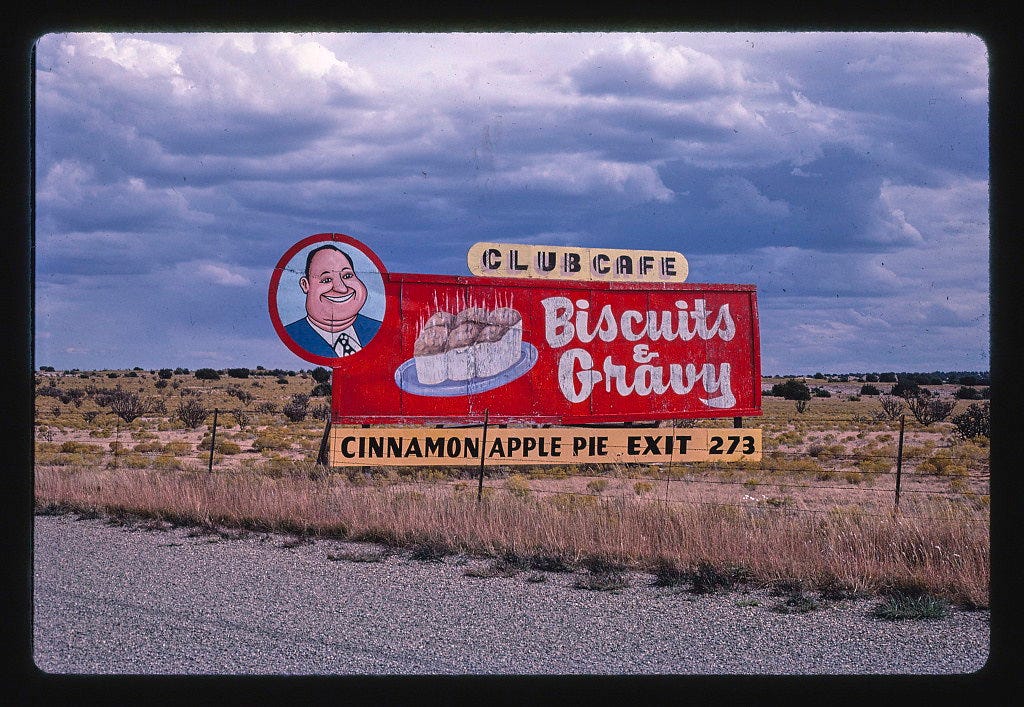
John Margiole. “Club Cafe sign near Santa Rosa, New Mexico” (1987) Library of Congress
The New Yorker was reporting on a the Shakespeare in the Park’s production of Romeo and Juliet, in Central Park. “The star-crossed lovers have a wedding of course,” writes Michael Schulman, “but their marriage is clandestine and tragically brief.” The director of the production adds that they want “to send the audience out with a little hope” after each performance. When the curtain closes, they host a real wedding. Out of thirty two productions scheduled, thirty couples booked for a post-teenage-tragedy tying of the knot. The director says “Let’s demonstrate that we have the capacity to overcome tragedy, to overcome our worst impulses.” As though the secret wedding of Romeo and Juliet was not a worse impulse. The couple they interview for the article blame the systemic forces for the tragedy of the under-age couple who “choose to die rather than love and exist.”1 There are some flaws in these interpretations—very generally—that I will not gnaw on. However, there is something here that is not uniquely, but characteristically, American. Hope.
Americans hate tragedy, even in literature where they are choosing to confront it, to analyze it, and face the meaning of difficulty. So, what do we do? We turn it into something hopeful.2 There is, in this example of matrimony, a kind of American bravado. They challenge fate, the divinely star-crossed lovers, by flaunting weddings in the face of this fiction—presumably and hopefully long lasting ones. They even take photos of the couple in front of a statue of the two ill-fated lovers. If it is not bravado, is it willful ignorance? A choice to ignore tragedy to replicate what we find beautiful? To blind ourselves to the grief around the corner? We have too much hope… or just enough.
We know Myth and Symbol makes generalizations. Most polls and research do the same thing with an added layer of mathematic security. American Studies scholar Miles Orville wrote a fundamental piece of contemporary AMST scholarship in his book The Death and Life of Main Street: Small Towns in American Memory, Space, and Community. Orville asserts that the idea of a Main Street is emblematic of America and its identity. This is a slight return to M&S. Orville even criticizes some of the critics for simplifying the methodology. He acknowledges that his thesis is hyperbolic, but states that “I am asserting the right to speak about American culture in general terms.” What strengthens Orville’s arguments is that he also utilizes the ideas that counter his thesis to build it up. In addressing counterpoints, he paints a much more complex picture of America. Can we do the same?
America is a nation that defies identity. Yet when you think of an American, something enters your mind. The American Dream? Patriotism? Racism? America posits itself a nation where anyone can be anything, so therefore it must deny the claim of an identity. It is not meant to have a single identity, but many. But can it have a character? I would argue that America is not a nation of creeds, religions, or a monolithic identity, instead, it is one of ideals. A character is built of ideals, motivations, and traits. These will not map one to one to every single citizen, but it need not. Perhaps we too can reserve the right to speak generally about American culture and still have it mean something.
One of America’s many ideals is that it is a—usually—deeply optimistic place. Even in the face of tyrannical miscarriages of justice and serious governance, opponents still find hope, still get married at the end of Romeo and Juliet. Hope helped the first Black American ascend to the Presidency—it was Obama’s campaign slogan. This optimism is flagging, perhaps. Our opposition to one administration soon extends to the system, and thus reaches beyond to something either uncontrollable or unattainable. Yet we organize. We try to do something about the problem regardless of the circumstances. We build communities. We still live. We still love. These are the things that, even beyond America, allow us to thrive.
What I want us to take away from this is that I think it is possible to accurately speak about American characteristics/ideals and it be meaningful. In part, it is a self serving conclusion as someone deeply interested in the notion of the American individual—which I think is largely mythic, but attainable. Understanding American ideals can help us—who are American citizens at least—find ways to be individuals. Can you be an individual who believes the same thing as a number of other people? Can you be an individual at all?
We can certainly hope.
Thank you for reading this meandering thought. Please share your thoughts and consider subscribing. It is free, as it always will be.
Michael Schulman. “The Happy Ending Romeo and Juliet Didn’t Get”, The New Yorker June 8 2026, 8-9.
This is not a criticism of this method of experience, in spite of my prior facetious tone.